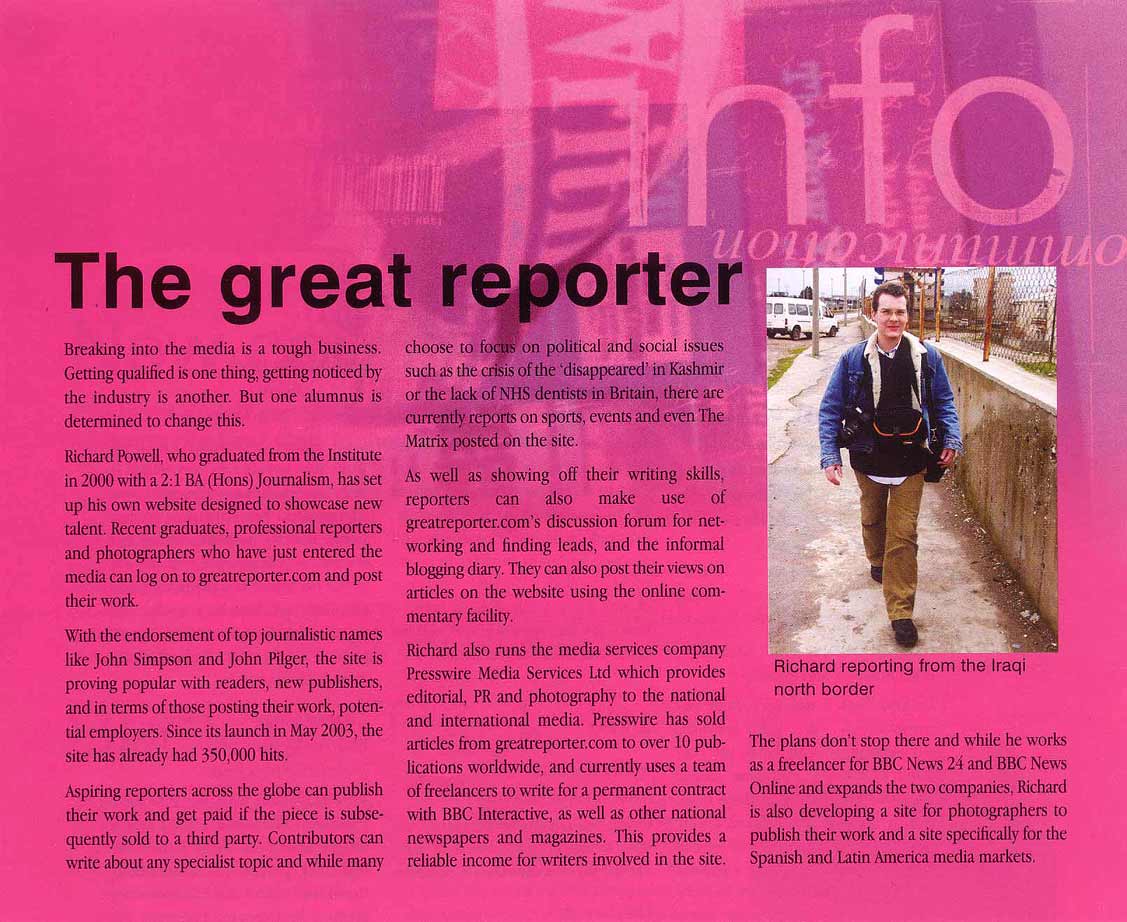
Documentary script · Written by Hipkins & Powell · Narrated by John McNaughton · Copyright 1999 LANA
Fade in moving shot of Old Havana from the bus
"This is the decaying facade of Havana's promenade. Though Cuba's regime is as rocksteady as ever, its buildings are not. Despite being declared a UN heritage site many examples of colonial splendour are crumbling beyond repair. Built by the Spanish who owned Cuba until 100 years ago many families still live precariously as the salt water continues to erode their homes. People like this man told us of the problems Cubans face living in such circumstances when overcrowding leaves no other option..."
Cut to man talking about state of building... police appear...
"Later on he had other explaining to do. After Castro's surprise new laws following Christmas, this man was questioned by the police and fined a week's wages. Harsh perhaps, but talking to the foreign press can now result in a 20 year prison sentence as a counter-revolutionary act."
Still shot of silhouette police photo
"In the shadow of Cuba's national assembly building, its record little more than a rubber stamp for Fidel Castro's speeches this man is subject to a random ID card check. The fate of citizens who fail to produce valid papers is explained by Carlos."
Cut to police ID check on bike / Cut to interview / Shots of jineteras
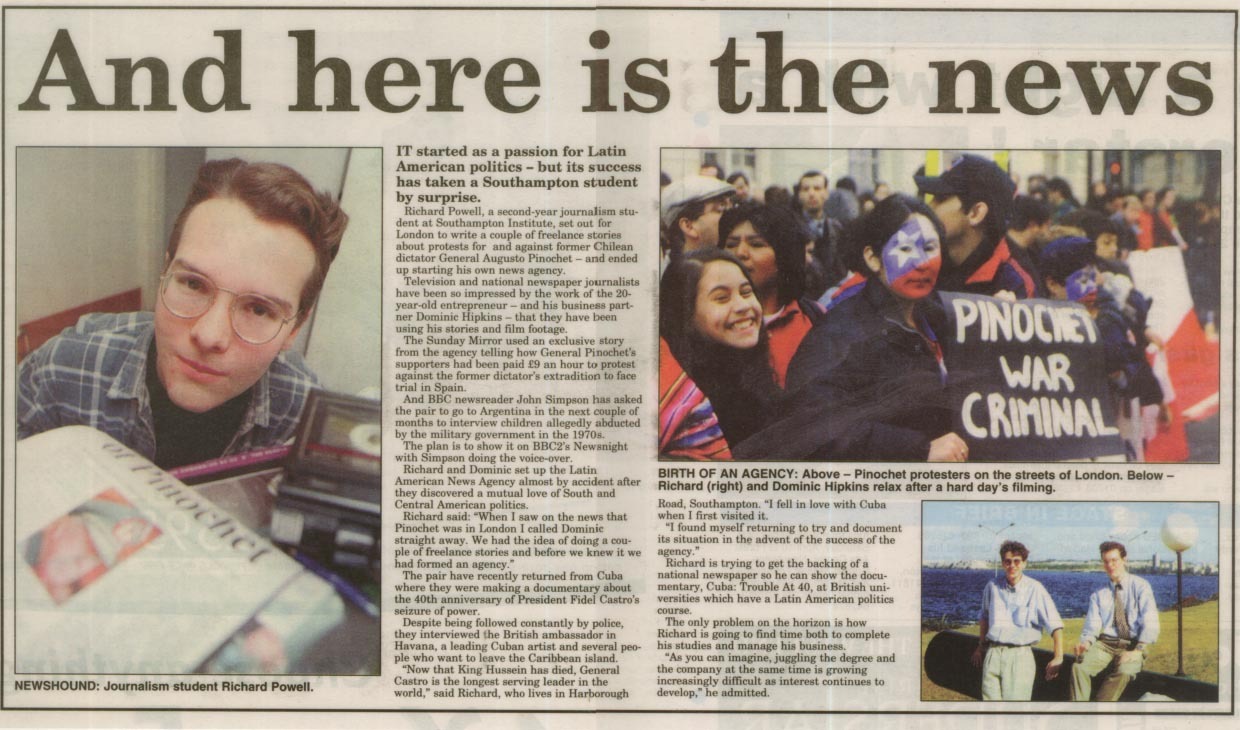
"The massive increase in tourism has given the island a reputation that echoes its playground past from the days before the revolution. The official line is that prostitution does not exist but the hundreds of girls who, until recently paced the promenade in search of dollars suggests a gap between rhetoric and reality. Prostitutes, or 'jineteras', as they are known are now targets of Castro's latest crackdown on those attracted by the promise of consumer goods in return for their services."
Cut to moving Nacional / Establishing shot of Nacional
"In the dying days of Batista's brutal and decadent rule the legendary gangster Meyer Lansky occupied the top floor of this world famous hotel before fleeing to Miami with the rest of the resident US mafia."
Shot of Al Capone / John Wayne / Errol Flynn / Winston Churchill / Nacional door with Christmas decorations
"Havana in the 1950's was dubbed the Paris of the Caribbean and the place to be seen for anyone from John Wayne... to Errol Flynn... to Winston Churchill."
"This is only the second time in 40 years that Christmas has come to Cuba. The festive celebrations, once deemed to be subversive, have returned to the island following a concession in the wake of last year's historic visit by Pope John Paul II. Many Cubans are rather bemused by the sight of Christmas trees and tinsel in the sweltering heat of Havana, still Santa Claus was certainly not welcome. Perhaps seen by the government as the ultimate symbol of capitalist consumerism, his presence was banned as counter-revolutionary."
Cut to night shot of Cubans revving up vehicles and driving off
"As Cubans prepare for a period of unprecedented economic growth fuelled by foreign investment and the influx of tourism it seems as with China there will be little accompanying political liberalisation. Senior sources in the British embassy maintain that as long as Fidel Castro remains the 'maximum leader' any political openings will meet a firmly closed door."
Shot of lighthouse
"Once the beacon of third world independence, Cuba now seems adrift in the turbulent waters of the global economy. Only 90 miles away Cuba maintains an uneasy stand-off with its all-powerful neighbour to the North. Nowadays the threat of an invasion seems unlikely as memories of the Bay of Pigs fiasco in 1961 linger on in Washington. The long standing US trade embargo is ritually condemned by the United Nations and has more recently been denounced by the Pope as 'ethically unacceptable'. It has undoubtedly hindered Cuba's economic development following the collapse of the Soviet Union and indeed seems a relic of the Cold War. If its objective was to dislodge Castro then it has failed its own foundations set more than 30 years ago."
Shot of out of focus malecon by night
"In spite of the difficult circumstances some Cubans go to extraordinary lengths to cope with conditions of rationing and food shortages..."
Cut to interview with 'fisherman' / Pan shots of swordfish / Fishing village on outskirts of Havana
"This fishing village on the outskirts of Havana seems a million miles away from the newly constructed hotel complexes that provide lucrative employment for citizens chosen to work there. The hard currency that tourism provides is a lifeline to an economy still reeling from the withdrawal of Russian subsidies 10 years ago. Tourism has even overtaken sugar exports as the primary source of income for the country with Fidel Castro affectionately calling it 'white gold'. Brain surgeons and teachers can earn up to ten times their usual wage by driving taxis or becoming tour guides. They are typical of many Cubans who have had to adapt to the new economic realities, a situation Fidel Castro calls the 'special period'. The collapse of the Warsaw pact countries meant Cuba lost 90% of its foreign trade overnight and was a bitter blow that left the economy reeling."
Shot of man flicking greenbacks / Shots of marketplace
"A few years ago this man's handling of dollars was considered a serious offence, their reluctant legalisation was more a tactical necessity than any ideological conversion by the Cuban government. Other tentative steps taken towards a market economy meant surplus produce could be sold by individuals and 'paladors' or family run restaurants were allowed, though subject to stringent rules. It remains that tourism has been the major factor behind Cuba's economic revival. The government's joint ventures with Spanish and Canadian companies seek to tap the holiday potential of what an enraptured Christopher Columbus described as 'paradise'."
Shot of Columbus / Child's picture of new airport terminal
"Unlike Columbus's experience, visiting Cuba is made easier with regular flights to the new multi million dollar international terminal — Jose Marti airport."
"The dollars that tourism provides have been both a lifeline and a curse. Those with access to dollars are still in a minority and most Cubans receive almost worthless pesos. A form of economic apartheid exists which has caused resentment and confusion. The gleaming consumer goods in dollar shops are tantalisingly out of reach of all but a few. Ironic given the legacy of the revolution where equality was always emphasised, in theory at least. Indeed Cuba seems beset by contradiction. The once fresh revolution — now a beleaguered institution — but still demands the unquestioning devotion of its citizens."
Cut to Siempre Rebeldes UJC pan shot / Guard outside the museum of revolution / UJC Che T-shirt / CDR signs and buildings
"According to official figures 95% of Cubans voted to endorse a government approved list of candidates last year. Cubans are expected to join an organisation called the committee for the defence of the revolution which has branches in every neighbourhood. The government maintains these are an instrument of grass roots democracy but all too often provide a constant watch for any sign of dissent. Strangely, no independent trade unions exist in this worker's state and strikes are illegal."
Shot of Granma international / Dissident interview
"The state run media seems more concerned with past glories than debating contemporary issues. In a recent case two journalists publishing underground publications were jailed for jeopardising national security. The climate of mutual suspicion and hostility between Cuba and the US has left precious little breathing space for voices that dare to differ."
"A balanced picture of Cuba has been the first casualty in a war of words and ideology caught in the crossfire between a defiant Castro and the nine US presidents that swore to depose him."
Shots of cigar shop and cigars
"The second of them, Kennedy, who bungled the Bay of Pigs invasion, procured a stockpile of cigars before ordering the trade embargo that exists to this day. The world's finest tobacco has featured prominently in US-Cuban relations in a saga that has frequently reached farcical proportions. In one of their nine estimated assassination plots, the CIA even sent the Cuban leader an exploding cigar. Like efforts to put poison in his shoes that would result in Castro losing his famous beard, it failed. In an act of self-sacrifice Fidel gave up cigars to promote his national anti-smoking campaign several years ago."
"Under the 'Trading with the enemy Act' Americans who share Kennedy's taste for the Monte Cristo or the Cohiba can be fined up to $100,000 by their government."
Shot of US flag from behind the fence / Interview with American
"US citizens are prevented from visiting Cuba under the Helms-Burton Act with the threat of heavy fines and even imprisonment. Recently some defied this law despite the consequences like this man we met in downtown Havana..."
"Apparent by the yachts moored in this marina are others whose desire to travel is incompatible with America's foreign policy. Among this unlikely band of affluent rebels was the yacht of Coca-Cola's chairman — Charlie Monger."
Cut to kids in fishing village
"If Americans find it difficult to come to Cuba, perhaps they should consider the Cubans journey across the Miami straits which is fraught with danger and uncertainty. Over 1 million exiles form a fierce opposition to the rule of Fidel Castro in Florida and many have relatives in Cuba, contact between whom is not easy."
Shot of telephone
"This has recently been made even more difficult following Castro's order to cancel telephone links with the US due to an outstanding bill incurred by American phone companies. Many in Miami have a dubious background going back to the days of Batista and links with the CIA whilst others are disillusioned one time supporters of the revolution. The early years of the revolution saw numerous sabotage attempts including hijacking and bombings — the work of exiles backed by the CIA. A more recent example was a plane dropping propaganda leaflets, subsequently shot down in Cuban airspace in March 1996. This resulted in the punitive Helms-Burton law which sought to prevent foreign investment in the island and complete the task of what John F. Kennedy called 'the building of a wall around Cuba'."
Shot of 'Senor Imperialista: We have absolutely no fear of you...' / Establishing shot of Fusta's place
"The siege mentality that resulted was used by the regime to maintain a vice like grip on political expression that shows no signs of easing. Inevitably the one party model tolerates little criticism but still has a base of support from an older generation of Cubans who revere Castro as an anti-imperialist icon."
"One man who can remember life before the revolution is the internationally renowned artist Jose Fuster — regarded in Cuba as the Picasso of the Caribbean. He began painting at a time when the unshaven rebels in the mountains only dreamed of victory. Cuba's rich cultural life is nourished and force fed by the ideals of the revolution."
Shots of Fuster's paintings / Man working on carving / Plaza d'Armas and books
"Indeed the gains of the revolution means Cuba has a system of social welfare that is the envy of the rest of Latin America. The health service in particular is regarded as a glittering prize and a symbol of understandable national pride — the statistics speak for themselves. Life expectancy and infant mortality rates compare favourably with some western nations including major cities in the US, including Washington DC."
"Literacy is almost 100% and Cubans are recognised as being highly skilled and culturally advanced. In Havana many people now speak English fluently as a second language, where Russian and German once prevailed. Though the education system is regarded as technically excellent its scope has been questioned. Marxist-Leninist philosophy is still a major course in universities, though figures have fallen dramatically in the last few years."
Shot of Lenin painting / School children stills
"In primary schools young children or pioneers salute the flag and sing songs to the memory of Che Guevara in their immaculate red uniforms. Nostalgia for this James Dean of revolutionaries continues to be of almost religious proportions. In the west Che's gaze remains a marketable commodity but to the Cubans it remains the most vivid expression of those who founded this society."
"Fidel Castro has astutely used this image of his martyred deputy to legitimise his own actions 30 years after Che was slain in the jungles of Bolivia attempting to export the idea of popular revolution. At 71, his appetite for power undiminished, the longest serving head of state in the world cuts a very different figure from that of the romanticised revolutionary."
Shot of revolution cubana picture
"Ritually re-elected at regular intervals by the national assembly, their near unanimous approval is compromised by the predictable absence of any other candidates. Attempts to demonise Castro as a brutal dictator by the US state department are responded to with relish by a man who points to America's involvement with regimes which are far more unpalatable than his own."
"Deteriorating relations in the early 60's resulted in US diplomats packing their bags. The old embassy is locked and deserted, a far cry from its status in pre-revolutionary days when it effectively ran the island and its presidents. Another superpower soon sought to replace America's influence."
Shot of the Russian embassy
"This imposing building is the Russian embassy — for nearly 30 years the nerve centre of Soviet influence in Cuba. The almost catastrophic missile crisis of 1961 is the most vivid memory of an era when Cuba's reputation far exceeded its actual power. This was an image Castro cultivated with an adventurous foreign policy that saw Cuban troops and doctors scattered around the globe. Cuba's encouragement of third world rebellion fuelled the paranoia of Cold warriors in the White House."
Shots of embassy buildings en route to Mirimar / Pan shot of map of the two countries
"Despite the disappearance of its old socialist bloc allies, Cuba is not as isolated as would be expected. Over 90 countries have ambassadors in Havana and world leaders no longer feel compromised by visiting Cuba."
"Whilst we were here the presidents of Venezuela and Colombia met with Castro to seek his advice and experience about problems in their own countries. Castro's outspoken views on foreign debt and economic neo-liberalism have lead many underdeveloped nations to have a sneaking respect for him. However, the leader's mortality is an issue never discussed here that undoubtedly lurks in the back of many minds. Observers with a vested interest in this island's future all agree with one thing — the hope for a peaceful transition following the death of the revolution's architect. Cubans refer to this prospect simply as 'after'."
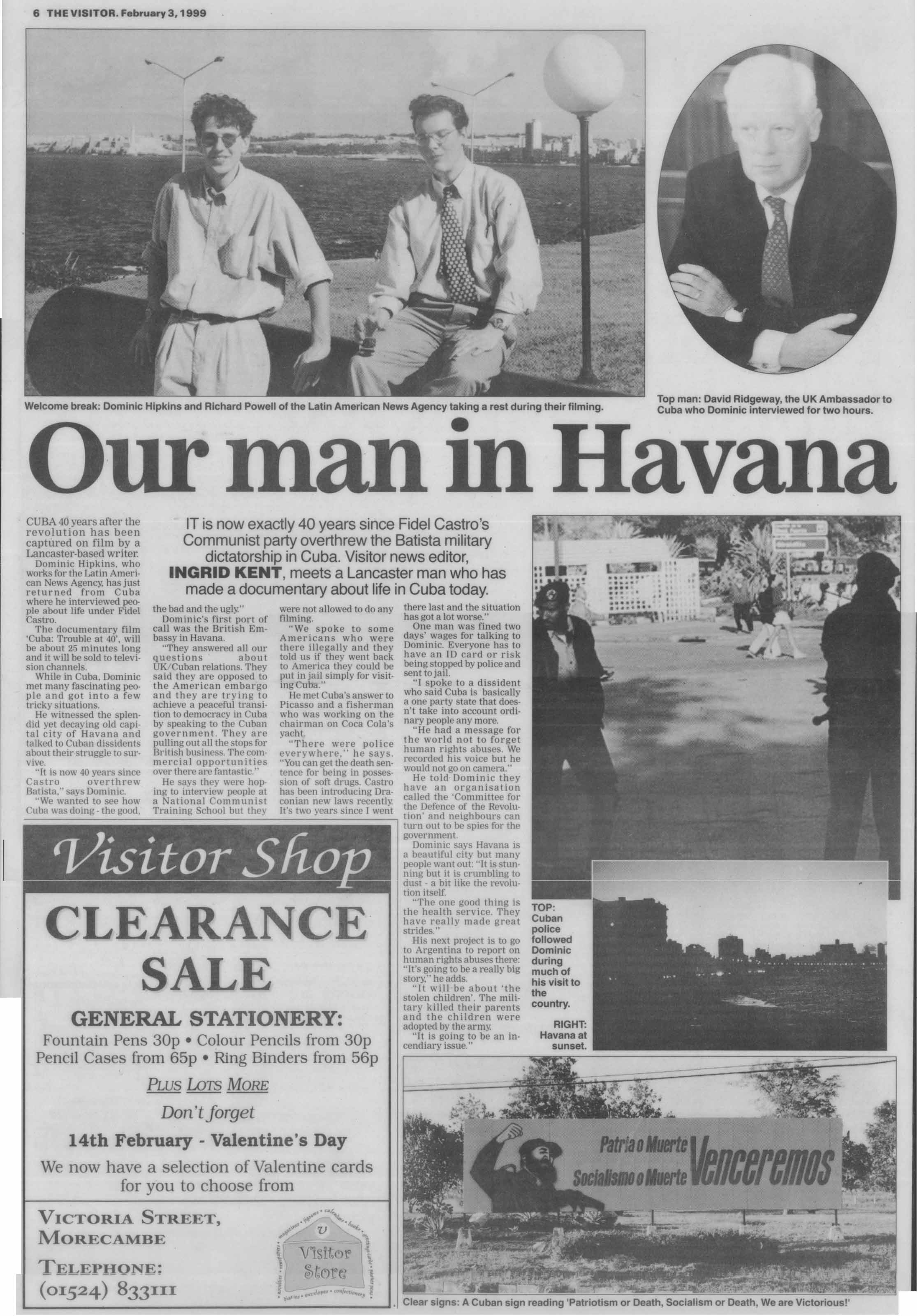
Shot of Robaina / Establishing shot of embassy / Shot of Ridgeway and Dom
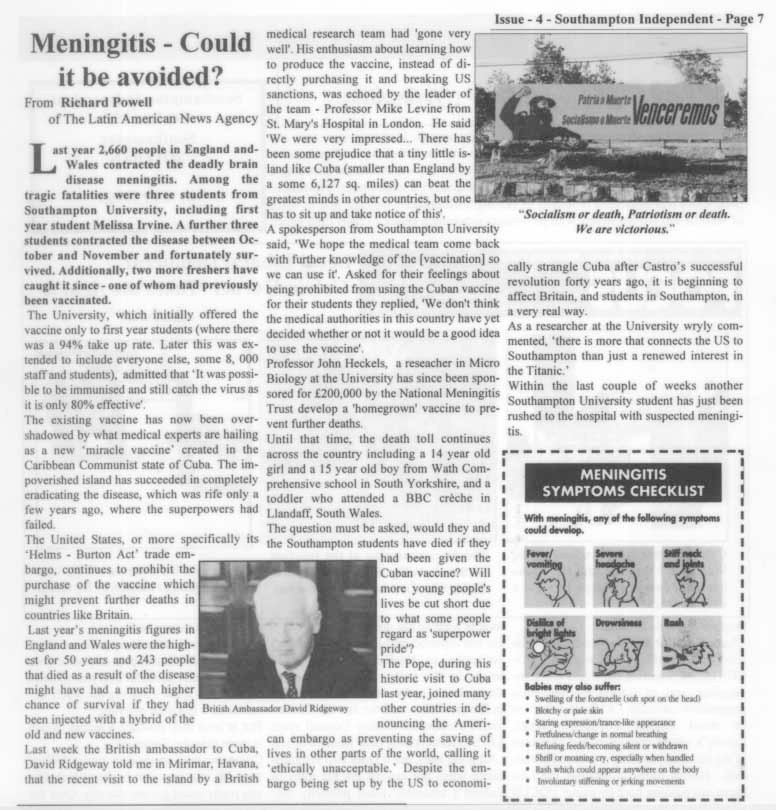
"Our man in Havana, ambassador David Ridgeway, is a seasoned veteran of diplomacy in Latin America and a firm advocate of a policy of 'constructive engagement'. This involves an 'active dialogue' with the Cuban authorities that seeks democratic change but not at the cost of mutual co-operation. One area where the UK and Cuba have worked closely is in cracking down on narcotics trafficking in the Caribbean."
"International sympathy for Cuba's great leaps forward in social policy is tempered by reservations concerning that most controversial of issues — human rights. Around 200 political prisoners were released following the recent visit of Pope John Paul II, but even so people willing to speak out publicly are still few and far between."
Dissident interview / Moving shots of central and old Havana including Malecon
"The majority of the discontent realise the consequences of harassment, unemployment and possibly prison make a still tongue, if not a happy life, then at least a quiet one. These streets witnessed the last public expressions of opposition in the 1994 food riots which briefly wrong-footed the regime. Angry mobs vented their fury by ransacking a popular hotel. The unrest, resulting in the deaths of two policemen culminated in the attempted hijacking of a ferry. In the end Cuban vigilante groups loyal to Castro quickly put down this potential uprising."
"Though Cuba seems tranquil today memories of the desperate events seven years ago lie just beneath the surface. In precarious home made rafts and rubber tyres up to 2,000 people a day decided to brave the 90 miles to Miami. For once the United States seemed reluctant to admit the would-be refugees. The grim consequence: whole families dying at sea, some drowning others whose fate requires little imagination in the shark infested waters."
"But on December 18th last year a tragic incident happened which received little mention in the international press. A boat en route to Miami capsized killing all 84 of its Cuban passengers. Despite these tragedies the desire to leave the island continues to lead Cubans to a largely unreported, similar fate."
Shot of backstreets / Shot of old woman sewing
"Life goes on for most Cubans as they learn to make do and mend with their increasingly threadbare revolution."
Shot of kids playing football / Girl with boyfriend on malecon / Happy kids on malecon
"The new generation of Cubans seem relaxed despite the uncertainty of the years ahead. A large proportion of the population are in their teens, more interested in sport music and consumer goods than the political slogans daubed across Havana, and the rest of the country."
"In the face of much adversity a society exists in Cuba where the street children and disease found elsewhere on the continent is noticeably absent. The bloody civil wars and death squad repression that plagued the recent history of most Latin American countries have never been features of Castro's Cuba. Nations with far greater resources and more favourable circumstances have either been unable or unwilling to enact the kind of social policies that the regime can always point to. For both better and worse Cuba has seen stability up until this, its 40th anniversary. On the brink of the millennium the toasting of past triumphs is at odds with life in the twilight years of Castro's rule."
Shot of Our Man in Havana book cover / Shot of hotel Sevilla / Shot of flag blowing in the breeze on malecon
"The intriguing story of Cuba's history makes a tale as fascinating as any celebrated novel set in the streets and hotels of this both charming and chaotic city."
"Though many people here can sense a wind of change it will take a mighty storm to achieve anything approaching a multi-party model of democracy. It undoubtedly possesses an authoritarian system that seems unresponsive to very real concerns. When not aloof to criticism it reacts in a heavy handed manner to ordinary Cubans without exception labelled 'collaborators with the United States'. Recently four 'dissidents' or subversives have been the first prosecutions following a new year crackdown on crime and unauthorised political activity. They were accused of subverting the socialist state and arrested on grounds of national security."
Shot of horse and cart travelling down road
"Their trial is subject to intense international scrutiny and their fate a reasonable indication whether Cuba will ultimately travel down the road of political reform."
Fade out / Shot of black and white of man turning on bike in Ciego / Fade in music / Roll credits
Copyright 1999 LANA · All rights reserved